Paying More for Less: What students really think about renting in Greater Manchester
Posted on: Tuesday, May 5th, 2026
“I don’t want to be homeless. These prices are getting higher every year”
Why this matters now
This year marks a turning point for student renters. The new Renters’ Rights Act will be coming into effect on the 1st of May 2026, and in Greater Manchester specifically the Good Landlord Charter is aiming to improve the standard of renting.
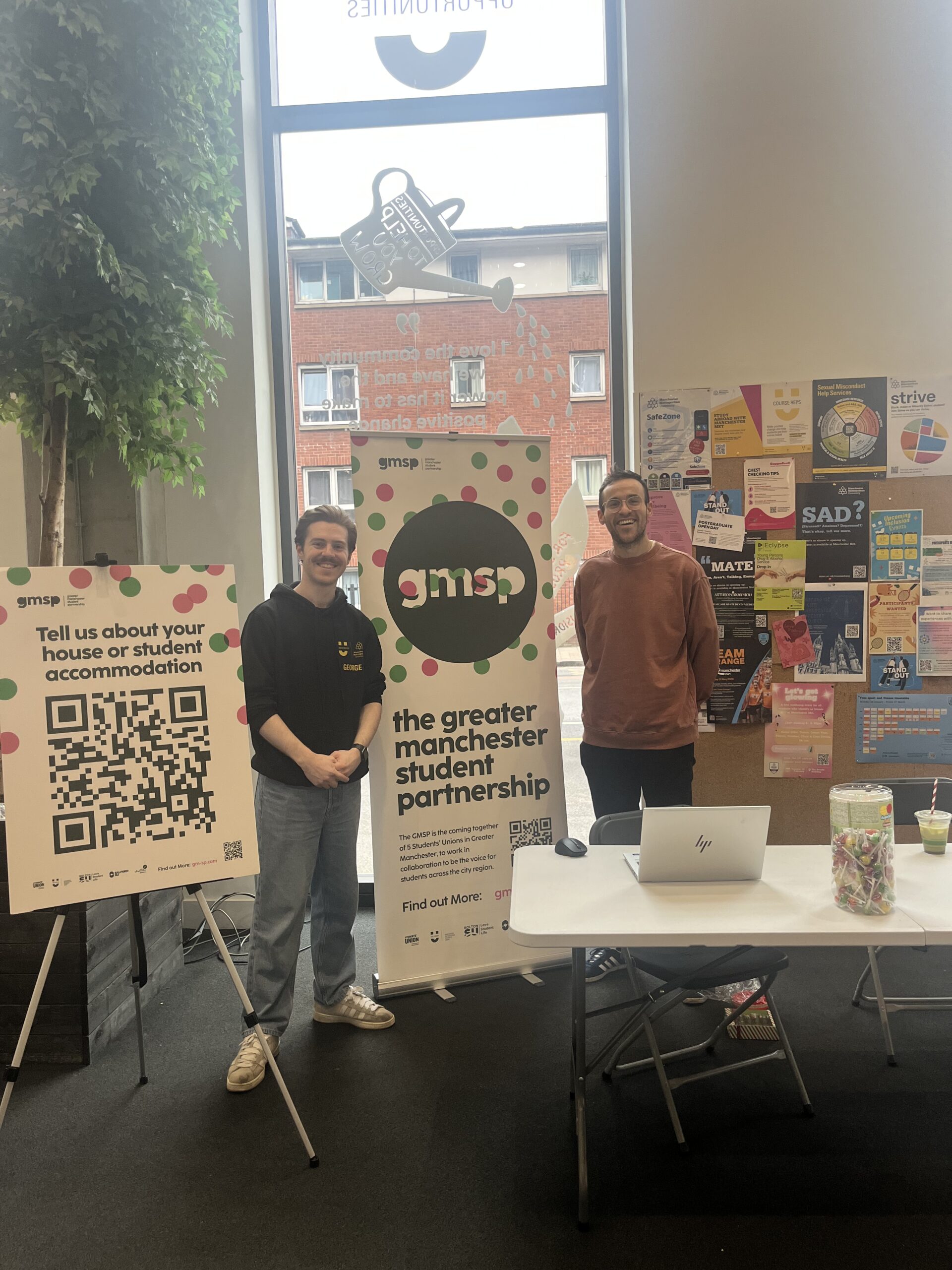
Both should bring positive changes for students, but what exactly are students thinking about their housing situation? The GMSP has created a survey to get feedback directly from students, as well as speaking to students in person at stalls in each of the five university Students’ Unions.
What are students actually saying about the state of student renting?
Financial precarity and fear of homelessness
One of the most striking findings was that 10% of students reported having experienced or expected to experience homelessness. When asked why, the majority reported that money was the main issue, with some citing the uncertainty associated with fixed, short-term student accommodation contracts.
Students described trade-offs between rent, food, transport, and tuition. One student explained how:
“We are always worried should we save money for rent, grocery or for tuition fee or for transport.”
Other students stated that:
“Whilst I don’t expect to, it remains a possibility as next year I will be doing a year long full time unpaid laboratory placement with a capped maintenance loan and I do not receive financial support from my parents. My future relies on my ability to get a good paying job over summer which is an incredibly difficult feat in Manchester.”
“Almost wasn’t able to pay my rent as my student loan doesn’t cover it (almost 2k out of pocket) this year”
“12 month lettings mean I’m having to pay 3 months extra rent when I don’t necessarily need the accommodation which Makes the maintenance loan not enough in my case”
“I couldn’t find affordable rent for 6 weeks so was homeless when I started uni and sofa surfed at a friend’s. The tram was very expensive from where I was staying in bury.”
These are not isolated budgeting issues; they reflect a structural mismatch between student income and housing costs. The Renters’ Rights Act aims to address that by ending section 21 “no-fault” evictions. This means that there are no longer fixed-term tenancies, creating more stability for students since they are not automatically kicked out of their property at the end of the academic year.
PBSA, like Unite Students and University accommodation, is exempt from these new rules and can continue functioning as usual. This is an important change that students and advice centres should be aware of.
Is it worth the rent: Quality vs. Cost
When asked whether their accommodation was worth the rent, only 51% agreed that it was good value for money. On top of this, 49% said that when they raised issues with their landlord, they were not dealt with in a timely manner. Some students felt they had found “good rent” in a “great location”. Others chose to live at home to save money. But many described being trapped in a system where high demand and limited supply leave them with little bargaining power.
One group of seven students reported paying £50,000 collectively for a property with a “gaping hole in the kitchen ceiling” and unresolved maintenance issues. Another described fixed-term contracts as “heinously predatory”, forcing students to pay rent during the summer months even though they are not actually using the property and getting “kicked out before the next tenancy commences leaving them stranded or paying high costs for temporary accommodation.”
The issue is not just cost. It’s power.
Power imbalance: knowledge, time, and choice
Once again, a key issue with students is that they do not know their rights. It is a perfect storm:
1. Inexperience
Students have never rented before and therefore they do not know how the rental system works, let alone the specific rules for students.
2. Time poverty
They are time poor. Many are juggling their studies, part-time work, and a social life. They lack the time and money to research their rights and challenge a landlord if their rights are transgressed.
3. Lack of choice
Right now, there are more students than properties, creating a scramble at the start of the year to secure a reasonably priced property for the following academic year. This desperation allows landlords to keep upping the rent and renders property reviews ineffective since students have little choice (there are 4000 more students than available beds). When choice disappears, standards slip.
So, what do students need to know?
The Renters’ Rights Act went live on the 1st of May 2026 it will undoubtedly bring a chaotic year as both landlords and tenants get to grips with the new system. While there will be more flexibility for tenants, there are some key changes that they need to be aware of.
While tenants only need to give two months’ notice, they could be liable for rent if they do not give notice before they want to leave at the end of the academic year.
Decent Homes Standard should also improve the quality of student housing, especially in combination with the Good Landlord Charter in Greater Manchester.
As ever, there are many exceptions for student accommodation. Ground 4A replaces the fixed-term tenancy by allowing landlords to ensure that they can get their student property back at the end of the academic year.
What will be a big relief to students is that Ground 4A can only be used if the tenants signed the contract more than six months before it starts. So, essentially, a tenancy starting in July cannot be signed before January and a tenancy starting in September cannot be signed before March. This will end the anxiety inducing pattern of student house hunting starting in October or November for the next academic year. While landlords can still advertise and students can informally agree to a deal, they cannot formally sign a contract until they are in that six-month period before their tenancy is due to start.
Another exciting development is that landlords now have very few grounds to refuse pets.
Ultimately these changes offer tenants and students in particular more flexibility and more security at the same time.
What should happen next
The Renters’ Rights Act and the Good Landlord Charter offer an opportunity to reset the relationship between students and landlords. Greater stability, clearer notice periods, and higher standards could significantly improve the student renting experience.
But policy alone will not solve the problem.
Students need accessible advice, clearer communication, and confidence in asserting their rights. Advice centres, Students’ Unions, and universities themselves will play a critical role in navigating the transitional year. As well as this, enforcement bodies have an important role to play in ensuring that new standards are meaningful rather than symbolic.
The survey responses make one thing clear: students are not asking for luxury. They are asking for stability and fairness.
If this new era of renting is to succeed, housing should feel like a foundation for education rather than a threat to it.
If you want to understand further how the new Renters’ Rights Act will be affecting you from the 1st of May, check out these websites:
https://www.theunionmmu.org/articles/all-you-need-to-know-about-the-renters-right-act-2025
By Penny Hampden-Turner